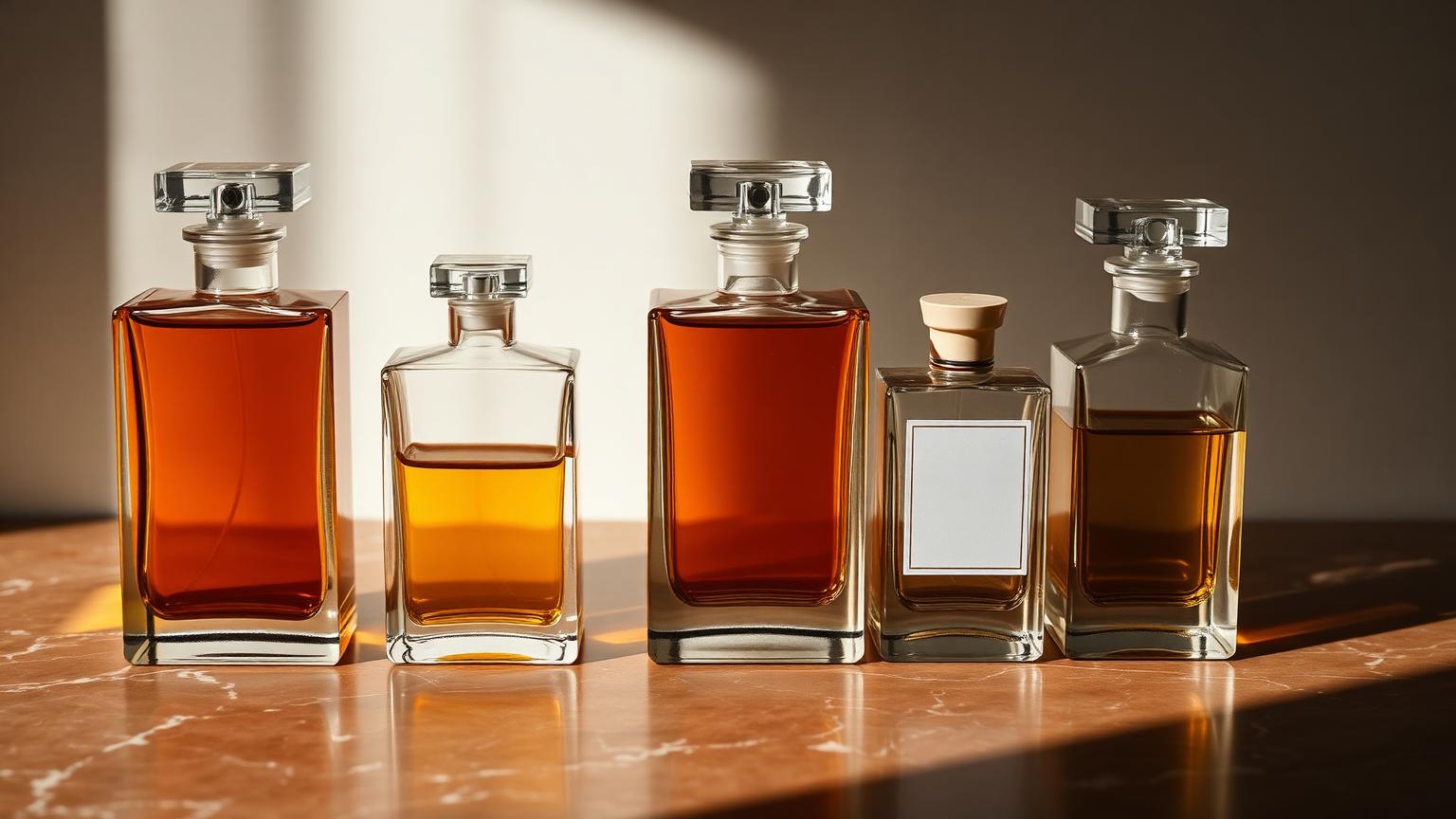
The words on a bottle — parfum, eau de parfum, eau de toilette, eau de cologne — describe one thing: the percentage of fragrant oils suspended in alcohol. Everything else flows from that ratio. Longevity, projection, the order in which notes appear, even the way a composition smells on warm skin versus cool skin — all of it traces back to concentration.
Understanding the concentrations is the difference between buying a fragrance and knowing how it will behave by the end of the day. It is also the difference between applying correctly and applying as though every fragrance behaved the same way, which it does not. A well-chosen EDP applied like an EDT will fade by lunch; a well-chosen parfum applied like an EDP will quietly take a room hostage.
Parfum (20–30% oils)
Parfum — also called extrait de parfum or simply extrait — is the richest, longest-lasting form a fragrance comes in. The oil concentration is high enough that the alcohol carrier evaporates faster than the composition, leaving the notes to settle close to the skin for eight, ten, sometimes twelve hours.
Parfum is worn close to the body. It does not project the way an EDP does; it reveals itself only to those near you, which is the entire point. Apply sparingly — one touch from a stopper to a pulse point is usually enough, and never more than two. Most refined fragrance wearers reserve parfum for evening, for occasions where intimacy of presence matters more than reach, or as their everyday wear when a single application in the morning is meant to last until they undress.
Eau de Parfum (15–20%)
The modern default for evening and considered daywear, and the strength most niche and luxury houses now lead with. EDP lasts six to eight hours on skin with moderate sillage — present enough to be noticed at conversational distance, restrained enough to leave a meeting room without trailing.
An EDP rewards a slightly heavier hand than parfum, but only slightly. Two sprays to the chest and a single spray to one side of the neck is usually sufficient. EDP is also the concentration in which most contemporary perfumers prefer to compose, which is to say it is often where the most considered version of a fragrance lives. If you are choosing between an EDP and an EDT of the same name, the EDP is rarely the wrong answer.
“EDP is the strength in which most contemporary perfumers prefer to compose.”
Eau de Toilette (5–15%)
Lighter, brighter, and more diffusive in the opening. EDT shines in warm weather, at work, in any setting where presence at conversational distance is the aim and where heavier compositions would overstep. Expect three to five hours on skin, and a more prominent top-note arc — citrus, green notes, light florals, aquatic accords — than the same composition in EDP.
EDT also rewards generous application in ways EDP does not. Four or five sprays in a citrus EDT in summer is not too much; it replaces, throughout the morning, what evaporates within the hour. This is why traditional eau-de-toilette wear in the south of Europe was almost a ritual of reapplication — the lighter dose was always meant to be refreshed.
Eau de Cologne (2–5%)
The most fleeting form, and the most ritual. Cologne is citrus-led, refreshing, and designed to be reapplied. A classic cologne — hesperidic, with neroli and petitgrain — was meant to be splashed on liberally after a bath, then again before lunch, and again before dinner. The pleasure is in the act of reapplying as much as in the scent itself.
Cologne is not a statement; it is a gesture. It does not last because it is not meant to. A 200ml or 500ml splash bottle on the bathroom shelf, used generously and without ceremony, is the right shape of cologne wear. Expect one to two hours on skin per application, and treat the brevity as part of the form.
Choosing by strength, not by name
The same fragrance in EDP and EDT is not simply weaker or stronger; it is reformulated. The proportion of top, heart, and base notes shifts to suit the different evaporation rate, and the two versions can smell genuinely different on the skin. The EDP of a familiar name will often feel rounder and warmer; the EDT will feel sharper and more vertical. Always sample both before assuming one is a thinner version of the other.
Concentration is also the variable that lets a single fragrance work across the day. A wearer who loves a particular composition might buy the EDT for summer and the EDP for winter — or the EDP for evenings and the EDT for travel. Read the label as information about behaviour, not as a hierarchy of quality. There is no virtue in choosing the strongest concentration; there is only the question of whether the strength suits the wear.
Continue reading
The Art of Layering Fragrance